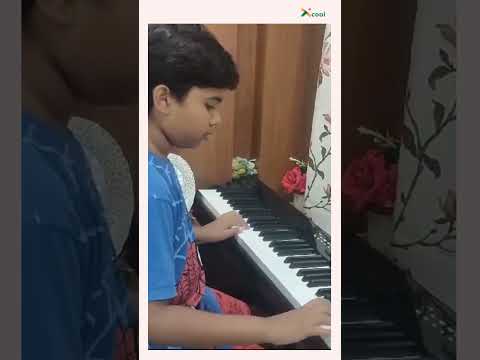
Piano for Trinity Grade 6 by Arougya Thami
- Selection includes at least one piece from each group.
- Accuracy and fluency in complex passages.
- Expressive control, phrasing, and dynamics.
- Exercises: Candidates prepare three exercises—one from each group (Group 1, Group 2, and Group 3).
- Demisemiquaver triplets, double-dotted notes/rests, duplets, hemiola, swung quavers.
- All major and minor keys, including:
- Bb and D major, Bb and D minor (harmonic and melodic).
- Chromatic scales in similar motion starting on Bb and D.
- Chromatic scale in contrary motion starting on Eb (two octaves).
- C major scale in 3rds (one octave).
- Identify the key to which the music modulates (subdominant, dominant, or relative minor).
- Locate changes in the music and describe them as pitch or rhythm variations.
- Understand the basics of SATB (Soprano, Alto, Tenor, Bass) writing, including proper voice leading and spacing.
- Compose simple harmonic progressions in SATB format, focusing on smooth transitions and balanced voicing.
- Focus on hand independence and coordination.
- Use slow, deliberate practice for challenging technical sections.
- Develop endurance and technique with Hanon No. 1–20, incorporating dynamic variations.
- Performance of technical exercises, scales, and arpeggios.
- Sight-reading assessment.
- Aural tests and general musicianship evaluation.
This 48-hour advanced online course offers one class per week, taught by our expert instructors. Refine your skills with personalized mentorship and elevate your expertise as you progress toward certification with confidence!
1. Repertoire
Candidates perform a balanced programme of three pieces from the Grade 6 repertoire list, ensuring:
2. Musical Theory
✓ Scales (natural, harmonic, and melodic minor).
✓ Key signatures, arpeggios, broken chords, dominant 7th broken chords.
✓ Tonic triads (root, first, and second inversion).
3. Technical Work
Scales (four octaves, hands together):
4. Aural Skills
5. Understanding SATB:
5. Practice Tips:
6. Assessment Methods:
- Develop advanced technical skills, fluency in scales, arpeggios, and expressive phrasing.
- Gain a deeper understanding of complex rhythms, harmonic structures, and modulation.
- Enhance aural skills, sight-reading, and overall musical interpretation.
- Build confidence and readiness to appear for the Trinity Grade 6 Piano examination.
Trinity College London
Course Highlights
Features
Expert-designed curriculum
Access to textbook, audio & video resources
Outcome oriented course design
Free demo
Get to know the Teacher
Discuss what you would like to learn
See what they've learned