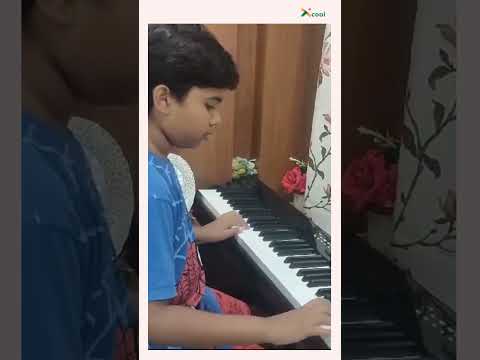
Keyboard for Trinity Grade 1 by Jayanta Lal Biswas
- Recognizing treble and bass clefs, note values, and rests.
- Understanding time signatures, simple rhythms, and basic articulation marks.
- Introduction to dynamics (p, f, mf, crescendo, diminuendo).
- Identifying and playing chord symbols and progressions.
- G major, D minor (hands separately).
- Dorian scale on G, Dorian scale on D.
- G major pentatonic, D major pentatonic.
- Blues scale on D.
- Chromatic scale in contrary motion starting on D.
- Chord progression of I–V in G major and D minor.
- Playing one of the above scales in the RH while accompanying with chords I and V in the LH.
- Basic hand coordination exercises.
- Simple melodic phrasing and articulation practice.
- Developing rhythmic accuracy and fluency.
- Expressive playing using dynamics and articulation.
- Understanding the style and character of each piece.
- Candidates perform a short, unseen piece after 30 seconds of preparation.
- The exercise will be at a level lower than the exam to build confidence and reading skills.
- Recognizing differences in pitch, rhythm, and dynamics.
- Identifying simple intervals and melodic changes.
- Responding to a short piece played by the examiner with musical observations.
This 18-hour beginner-friendly online course offers one class per week, taught by our most experienced and qualified teachers. Get personalized guidance and start your certification journey with assurance!
1. Music Notation & Theory
2. Chords /Scale construction
Chord Formulas: Students will learn the construction of basic chords, including major and minor triads, to understand harmony.
Scale Formulas: Students will be taught the formulas for major and natural minor scales to build a strong foundation in melody creation.
3. Keyboard Exercises
Scales & Chord Knowledge:
Keyboard Technique & Finger Exercises:
4. Repertoire
Candidates perform three contrasting pieces from the Trinity Grade 1 syllabus, focusing on:
Sight Reading
Aural Skills
- Students will confidently play pieces with both hands, combining melody and simple harmonies.
- They will demonstrate correct fingering and hand coordination for basic scales and chord progressions.
- They will develop sight-reading and aural skills necessary for further musical growth.
- By the end of the course, students will be well-prepared for the Trinity Grade 1 Keyboard Exam.
Trinity College London
Course Highlights
Features
Expert-designed curriculum
Access to textbook, audio & video resources
Outcome oriented course design
Free demo
Get to know the Teacher
Discuss what you would like to learn
See what they've learned